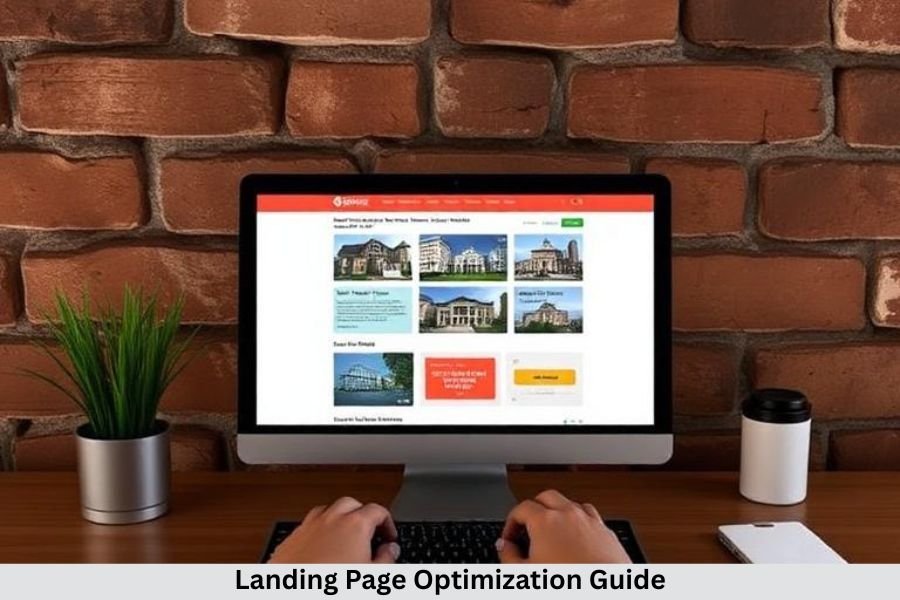
A landing page is a dedicated webpage designed with one primary goal: to convert visitors into leads or customers. Unlike traditional website pages that contain multiple navigation options and information sections, a landing page focuses on a single offer or action. This could include signing up for a newsletter, downloading an ebook, registering for a webinar, or purchasing a product. Think of it like a digital salesperson who greets visitors and immediately guides them toward one specific action.
In digital marketing campaigns—especially paid advertising, email marketing, and social media promotions—landing pages play a crucial role. Instead of sending traffic to a homepage where visitors may get distracted or confused, marketers direct them to a focused page designed to match the campaign’s message. This alignment between ad messaging and landing page content is often referred to as message match, and it dramatically increases the chances of conversion.
Landing pages are particularly powerful because they remove unnecessary distractions. A typical website homepage may have dozens of links and options competing for attention. A well-designed landing page, on the other hand, acts like a guided path that leads visitors toward a clear outcome. This simplicity is what makes landing pages one of the most effective tools for online lead generation and sales.
In many ways, a landing page functions like the final stage of a marketing funnel. After attracting visitors through ads, search results, or social media, the landing page becomes the moment of truth where a visitor decides whether to take action or leave.
Why Landing Page Optimization Matters for Marketing
Creating a landing page is only the first step. The real magic happens when marketers continuously improve and refine the page through Landing Page Optimization (LPO). This process focuses on improving design, messaging, layout, and user experience so that more visitors convert.
Without optimization, even a well-designed landing page can underperform. Imagine running a paid advertising campaign that brings thousands of visitors to your website. If the landing page fails to convert those visitors, your marketing budget is essentially wasted.
Landing page optimization helps businesses maximize the value of every visitor. Instead of spending more money on traffic, marketers improve the page itself to generate better results. This approach is often far more cost-effective than simply increasing advertising budgets.
Data shows that landing pages can significantly outperform other signup methods. In fact, landing pages convert about 160% better than standard sign-up forms, making them a powerful tool for lead generation and customer acquisition.
The optimization process usually involves analyzing user behavior, testing different design elements, and continuously refining the page based on real data. Over time, small improvements accumulate and can dramatically increase conversion rates.
Businesses that take landing page optimization seriously often experience better ROI from marketing campaigns, stronger lead generation, and improved customer engagement.
Landing Page Conversion Benchmarks
Average Landing Page Conversion Rates
Understanding industry benchmarks is essential when evaluating the performance of your landing page. Many marketers assume their page is performing poorly when it might actually be performing within industry averages.
Studies analyzing thousands of landing pages reveal that the median landing page conversion rate is around 6.6% across industries. This means that roughly six out of every hundred visitors complete the desired action, such as filling out a form or making a purchase.
However, conversion rates can vary widely depending on factors like industry, traffic source, and offer type. Some datasets report lower averages—around 2.35% conversion across industries—while others show higher performance for optimized campaigns.
This variation happens because not all landing pages are created equal. Some pages are designed specifically for high-intent audiences, while others target broader audiences who may not yet be ready to convert.
Another important factor is traffic quality. For example, visitors who arrive from email campaigns or webinar promotions tend to convert at higher rates because they already have a relationship with the brand. On the other hand, social media traffic may convert at lower rates because those visitors are often still in the discovery stage.
These benchmarks should serve as a guideline rather than a strict rule. What matters most is continuously improving your own conversion rate over time.
What Is Considered a Good Conversion Rate?
Many marketers ask a simple question: What is a good landing page conversion rate? The answer depends on context, but industry benchmarks provide a helpful reference point.
A landing page converting around 5–7% is generally considered average across most industries. Pages that achieve 10% or higher are considered high-performing, and the top-performing pages can exceed 11% or more conversion rates.
Several factors influence whether a landing page reaches these levels of performance. The clarity of the offer, the design of the page, and the strength of the call-to-action all play important roles.
For example, research shows that optimizing headlines can increase conversion rates by up to 34%, while improving CTA placement can generate around 21% improvement. These changes may seem small, but when applied strategically, they can dramatically improve campaign performance.
The takeaway here is simple: a landing page is never truly finished. The best-performing marketers treat landing pages as evolving assets that constantly improve through testing and optimization.
Core Elements of a High-Converting Landing Page
Clear Value Proposition
A strong value proposition is the foundation of every successful landing page. When a visitor arrives on your page, they should instantly understand what you are offering and why it matters to them. If your message is unclear or confusing, visitors will likely leave before exploring further.
Think of your value proposition as the promise you make to your audience. It explains what problem you solve, how you solve it, and why your solution is better than alternatives. The best value propositions are simple, direct, and focused on benefits rather than features.
For example, instead of saying “Advanced productivity software for enterprise workflows,” a more effective value proposition might say, “Manage your team’s tasks and projects in one simple platform.” The second statement is clearer and easier to understand.
Another important aspect of a value proposition is relevance. Visitors arriving from a specific ad or campaign expect the landing page to match the promise made in that advertisement. If the messaging feels inconsistent, trust quickly erodes.
Successful landing pages often place the value proposition prominently at the top of the page, ensuring visitors immediately know they are in the right place.
Strong Headlines and Subheadings
Headlines are one of the most influential elements of a landing page. They serve as the hook that captures attention and encourages visitors to continue reading.
Research suggests that optimizing headlines alone can increase conversions by 12–20% in many cases. That’s because visitors often decide within seconds whether a page is worth their time.
Effective headlines share several common characteristics:
- They clearly communicate the main benefit.
- They use simple, easy-to-understand language.
- They directly address the visitor’s problem.
Subheadings also play an important role by supporting the headline and adding additional context. While the headline grabs attention, the subheading provides reassurance and encourages the visitor to keep exploring the page.
Together, headlines and subheadings create a narrative that guides visitors through the page and toward the conversion goal.
Designing a High-Converting Layout
Visual Hierarchy and User Experience
Design plays a crucial role in landing page performance. Even the most compelling offer can fail if the page layout is confusing or difficult to navigate.
Visual hierarchy refers to the arrangement of elements on a page so that the most important information receives the most attention. This is achieved through strategic use of size, color, spacing, and positioning.
For example, the headline should typically appear at the top of the page in a larger font size. The call-to-action button should stand out visually so that visitors can easily identify the next step.
Images and videos also contribute to visual hierarchy. High-quality visuals help illustrate the value of a product or service and make the page more engaging.
Studies show that 39% of marketers report higher conversions when landing pages include video content, highlighting the importance of multimedia elements in modern marketing strategies.
Good design is not just about aesthetics—it’s about guiding the visitor’s attention in a way that naturally leads them toward conversion.
Above-the-Fold Optimization
The above-the-fold section refers to the portion of a webpage visible without scrolling. This area is extremely important because it forms the visitor’s first impression.
A well-optimized above-the-fold section typically includes:
- A compelling headline
- A brief description of the offer
- A clear call-to-action
- Supporting visuals or trust signals
When visitors immediately understand the offer and see a clear next step, they are far more likely to stay on the page and continue exploring.
Creating Compelling Call-to-Actions
CTA Placement and Color Psychology
A call-to-action (CTA) is the element that instructs visitors to take the desired action. Without a clear CTA, even interested visitors may hesitate or leave the page.
CTA placement should feel natural within the flow of the page. Many high-converting landing pages include a CTA in multiple locations, such as the hero section, the middle of the page, and the final section.
Color contrast also plays a key role. When the CTA button stands out visually from the rest of the page, it becomes easier for visitors to identify.
Some marketers experiment with colors like orange, green, or red for CTA buttons because they draw attention without overwhelming the design.
Writing Action-Oriented CTA Copy
The wording of your CTA can significantly influence conversion rates. Instead of generic phrases like “Submit,” high-performing pages use action-oriented language that emphasizes value.
Examples include:
- Start My Free Trial
- Download the Guide
- Get Instant Access
This subtle shift focuses on what the visitor gains rather than what they must do.
Using Social Proof and Trust Signals
Reviews, Testimonials, and Case Studies
Trust is one of the biggest barriers to conversion. When visitors arrive on a landing page for the first time, they may feel uncertain about the credibility of the brand.
Social proof helps overcome this hesitation by showing that others have already had positive experiences with the product or service.
Testimonials, customer reviews, and case studies are among the most effective forms of social proof. When potential customers see real stories from satisfied users, they feel more confident making a decision.
User-generated content can also significantly improve conversion rates. Some studies show conversion rates increasing from 3.2% to around 7% when visitors interact with user-generated content.
Adding recognizable logos, certifications, and security badges further reinforces credibility and builds trust with visitors.
Optimizing Forms for Lead Generation
Reducing Friction in Form Fields
Forms are often the final step in the conversion process, especially for lead generation campaigns. If a form feels complicated or time-consuming, visitors may abandon the process.
One of the simplest optimization strategies is reducing the number of required form fields. Studies indicate that reducing form fields from five to three can significantly increase conversions.
The key is to request only the information necessary for the next step in the relationship. For example, an initial lead generation form may only require a name and email address.
Additional information can always be collected later as the relationship develops.
Clear instructions, simple layouts, and mobile-friendly form designs also contribute to higher completion rates.
Mobile Optimization for Landing Pages
Responsive Design and Mobile UX
Mobile traffic now accounts for the majority of website visits, making mobile optimization essential for landing page performance.
Research shows that over 86% of top-performing landing pages are mobile-friendly, highlighting the importance of responsive design.
Responsive landing pages automatically adjust their layout to fit different screen sizes, ensuring a smooth experience for mobile users.
Mobile optimization also involves simplifying navigation, using larger buttons, and minimizing typing requirements.
Fast loading times are especially critical on mobile devices. Even small delays can cause users to abandon the page before it fully loads.
By prioritizing mobile usability, businesses can capture a larger share of their potential audience and improve conversion rates.
A/B Testing and Continuous Optimization
Key Elements to Test for Better Performance
Landing page optimization is an ongoing process. Even well-performing pages can often be improved through systematic testing.
A/B testing involves comparing two versions of a page to determine which one performs better. Marketers may test different headlines, images, layouts, or CTA designs.
Over time, these experiments provide valuable insights into what resonates with your audience.
Many businesses discover that small changes can produce surprisingly large improvements. Adjusting a headline, simplifying a form, or changing the placement of a CTA button can sometimes increase conversions dramatically.
The key is to test one element at a time and analyze the results carefully. This data-driven approach ensures that optimization decisions are based on evidence rather than assumptions.
Conclusion
Landing page optimization is one of the most powerful strategies for improving digital marketing performance. Instead of constantly increasing advertising budgets, businesses can focus on improving the pages that convert visitors into customers.
By crafting clear value propositions, designing intuitive layouts, using persuasive calls-to-action, and continuously testing improvements, marketers can dramatically increase conversion rates.
Successful landing pages are never static. They evolve over time through testing, analysis, and user feedback. When approached strategically, landing page optimization can transform ordinary marketing campaigns into powerful lead-generation engines.
FAQs
1. What is the main goal of a landing page?
The primary goal of a landing page is to convert visitors into leads or customers by guiding them toward a specific action such as signing up, downloading content, or making a purchase.
2. What is the average landing page conversion rate?
Most studies suggest that the average landing page conversion rate ranges between 2% and 7%, while high-performing pages often exceed 10%.
3. How many landing pages should a business have?
Companies with multiple targeted landing pages often generate significantly more leads. Businesses with 10–15 landing pages can increase leads by about 55% compared to those with fewer pages.
4. Why do some landing pages fail to convert?
Common reasons include unclear messaging, weak value propositions, slow page speed, complicated forms, and poor mobile design.
5. How often should landing pages be optimized?
Landing pages should be optimized continuously through A/B testing and performance analysis. Even small improvements over time can significantly increase conversion rates.