Let’s be honest for a second. Modern classrooms are packed with textbooks, screens, and standardized tests. But something important often gets left outside the school gate — centuries of wisdom carried by Indigenous communities.
We’re talking about knowledge shaped by land, culture, survival, and deep observation. Not “old-fashioned ideas,” but living systems of understanding. So here’s the real question: Why isn’t this knowledge sitting next to math, science, and literature?
Education today is evolving fast. Skills like creativity, adaptability, and critical thinking are prized more than ever. And guess what? Indigenous knowledge naturally cultivates these abilities. Integrating it into classrooms isn’t just cultural respect — it’s smart education design.
What Is Indigenous Knowledge?
Definition and Core Characteristics
Indigenous knowledge refers to the understandings, skills, and philosophies developed by Indigenous peoples through long interaction with their environments. It’s local, experience-based, and passed down across generations.
Unlike conventional academic knowledge, it isn’t always written in books. It lives in stories, rituals, crafts, agriculture, medicine, navigation, and community practices.
Think of it as a library without shelves — dynamic, adaptive, and deeply contextual.
Oral Traditions and Storytelling
Before notebooks existed, there were stories. Oral traditions are the backbone of Indigenous knowledge systems. Knowledge travels through narratives, songs, proverbs, and ceremonies.
Why storytelling? Because stories don’t just inform — they stick. They carry emotion, memory, ethics, and identity. A lesson wrapped in a story becomes unforgettable.
Modern neuroscience even supports this. Our brains are wired for narrative learning. Stories activate more regions of the brain than raw facts.
Connection to Land, Culture, and Community
Indigenous knowledge is inseparable from place. It’s grounded in ecosystems, seasons, animals, and geography.
Where modern education sometimes abstracts learning (“Imagine a forest…”), Indigenous knowledge says, “Let’s walk into one.”
It’s experiential, relational, and holistic.
Why Indigenous Knowledge Deserves a Place in Schools
Preserving Cultural Heritage
Languages, customs, and traditions disappear when they aren’t practiced. Classrooms can either accelerate this loss or help reverse it.
Integrating Indigenous perspectives allows younger generations to see their heritage valued, not sidelined.
Education shouldn’t erase identity — it should strengthen it.
Enhancing Cognitive Diversity
Different knowledge systems train the mind differently. Exposure to Indigenous ways of thinking introduces students to alternative problem-solving frameworks.
Linear vs. cyclical thinking. Analytical vs. relational reasoning. Data vs. observation.
It’s like giving the brain multiple operating systems instead of just one.
Promoting Environmental Awareness
Indigenous communities have practiced sustainability long before it became a buzzword.
Traditional ecological knowledge teaches balance, stewardship, and respect for natural cycles. In an era of climate anxiety, this wisdom is gold.
The Benefits for Students
Critical Thinking and Problem Solving
Indigenous knowledge encourages students to ask deeper questions:
- How do humans interact with nature?
- What happens when balance is disturbed?
- Why do traditions evolve?
Instead of memorizing isolated facts, learners analyze systems and relationships.
Identity, Empathy, and Social Awareness
When students encounter diverse cultural narratives, empathy expands. Stereotypes weaken. Curiosity grows.
Representation matters. Seeing Indigenous knowledge respected in schools validates Indigenous students and educates non-Indigenous peers.
Real-World Learning and Practical Skills
Many Indigenous practices are inherently applied:
- Agriculture
- Craftsmanship
- Navigation
- Herbal medicine
- Conflict resolution
Learning becomes tangible, not theoretical.
Challenges in Integration
Curriculum Constraints
Standardized curricula often leave little room for localized knowledge. Teachers feel pressured to “cover the syllabus.”
But integration doesn’t require replacing subjects — it means enriching them.
Risk of Tokenism
A single “Indigenous Day” or decorative classroom poster isn’t integration. It’s symbolism.
Authentic inclusion requires depth, continuity, and collaboration.
Lack of Teacher Training
Many educators simply haven’t been trained to teach Indigenous perspectives confidently and respectfully.
Professional development is essential.
Practical Strategies for Educators
Co-Creating Curriculum With Communities
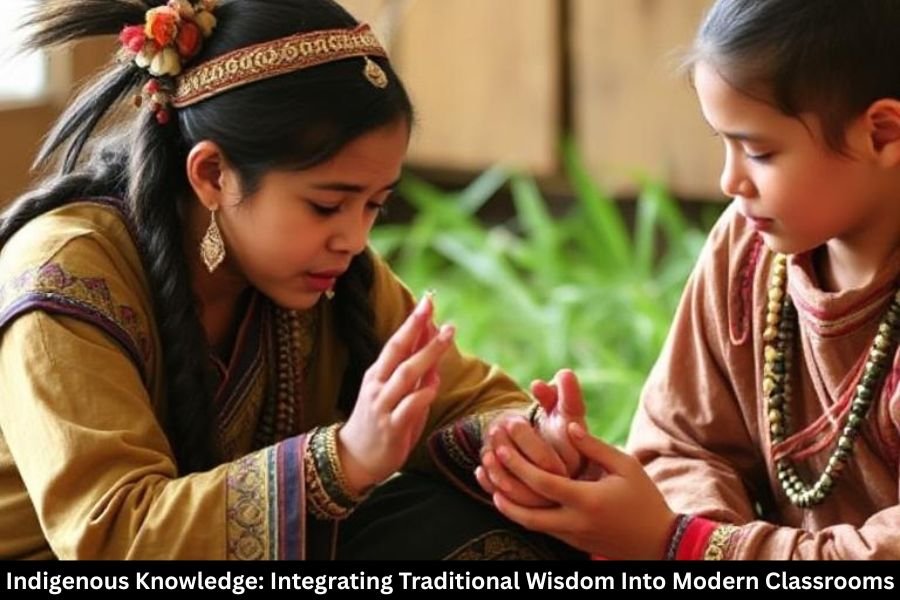
Who better to teach Indigenous knowledge than knowledge holders themselves?
Collaborating with elders, community leaders, and cultural practitioners ensures authenticity.
It also transforms schools into community-connected spaces rather than isolated institutions.
Incorporating Storytelling Methods
Teachers can adapt narrative-based teaching:
- Historical events as stories
- Scientific concepts through cultural metaphors
- Ethics via traditional tales
Learning becomes engaging and memorable.
Experiential and Place-Based Learning
Outdoor Learning Models
Why confine environmental science to slideshows?
Nature walks, local ecosystem studies, and observation exercises mirror Indigenous learning traditions.
Students don’t just read about biodiversity — they witness it.
Community Knowledge Keepers
Invite artisans, farmers, healers, or storytellers into classrooms. Their lived expertise adds richness textbooks can’t replicate.
Technology as a Bridge
Digital Archives and Preservation
Technology can help record languages, stories, and practices at risk of fading.
Organizations like UNESCO actively emphasize safeguarding intangible cultural heritage. Schools can tap into digital repositories to bring authentic resources into lessons.
Virtual Cultural Exchanges
Video calls and digital collaborations connect students with Indigenous communities across regions.
Geography stops being a barrier.
Global Examples of Success
New Zealand’s Māori-Centered Education
In New Zealand, Māori-focused schools (Kura Kaupapa Māori) integrate language, cosmology, and cultural values into mainstream education.
The result? Stronger identity, engagement, and academic outcomes.
Indigenous Education in Canada
Canadian programs increasingly embed First Nations perspectives into environmental studies, governance discussions, and history curricula.
Students learn that sustainability isn’t a modern invention — it’s ancestral practice.
Traditional Knowledge in India
In India, traditional systems like Ayurveda, Vedic mathematics, and local agricultural wisdom are finding renewed educational relevance.
Ancient doesn’t mean obsolete.
Ethical Considerations
Respect, Consent, and Representation
Indigenous knowledge isn’t a free resource to extract. It requires permission, attribution, and sensitivity.
Communities must be partners, not subjects.
Avoiding Cultural Appropriation
Using sacred symbols or teachings without context reduces living traditions to aesthetic accessories.
Integration must be respectful and informed.
The Future of Education
Blending Ancient Wisdom With Modern Science
Imagine combining traditional ecological observation with climate science. Or Indigenous navigation techniques with physics.
Innovation often lives at intersections.
Building Inclusive Learning Environments
Education works best when students see their realities reflected in learning materials.
Diverse knowledge systems create richer intellectual ecosystems.
Conclusion
Integrating Indigenous knowledge into modern classrooms isn’t nostalgia — it’s evolution. It broadens perspectives, deepens understanding, and humanizes education.
Because learning isn’t just about information. It’s about connection — to ideas, cultures, histories, and each other.
When classrooms make space for traditional wisdom, education becomes what it was always meant to be: a bridge between generations, not a filter that erases them.
FAQs
1. Is Indigenous knowledge relevant in modern, technology-driven education?
Absolutely. It complements modern learning by adding contextual, ethical, and experiential depth.
2. Can Indigenous knowledge be integrated without changing the entire curriculum?
Yes. It can enrich existing subjects like science, geography, literature, and ethics.
3. How can schools ensure respectful inclusion?
By collaborating directly with Indigenous communities and knowledge holders.
4. Does this approach benefit non-Indigenous students too?
Definitely. It fosters empathy, critical thinking, and global awareness.
5. What’s the biggest mistake schools should avoid?
Tokenism — superficial gestures instead of meaningful, sustained integration.